Six
Meter
Club
Fifteen world records, one centimeter at a time. This is the equation underneath it — and it works on your vault too.
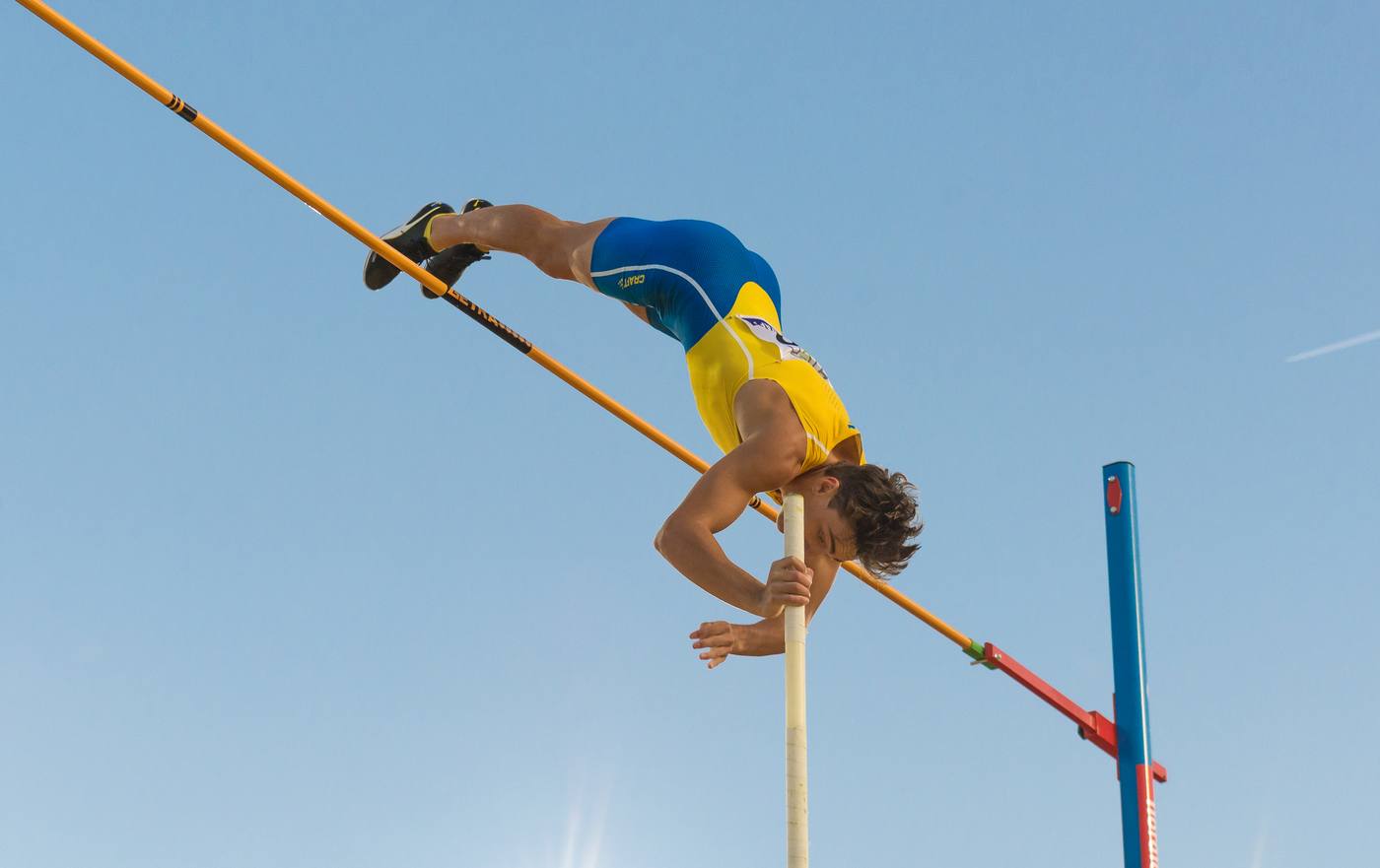
Armand Duplantis, 6.00 m, Stockholm Stadium, 24 August 2019 · Photo Frankie Fouganthin, CC BY-SA 4.0, via Wikimedia Commons
One line of physics. First bar to 6.31 m.
Every piece is a height. Add them up and you get the bar you can clear. On the same pole, better technique (θ, φ) only ever adds height.
Every term, in plain English
How the model predicts your vault
Every piece is a height. Add them up and you get the bar you can clear. On the same pole, better technique (θ, φ) only ever adds height.
What’s inside “Run speed (read off your grip)”
What’s inside “Pole shortening”
Where this model is actually tested
4.70 m to 6.31 m — six real vaults, 5.9 cm RMS. Two World Championship cohorts, the Olympic final mean, a WC winner, Duplantis, and one measured club vault. Every one has a real measured run speed and a real grip height, and the worst row is 10.5 cm out.
The 6.31 is a clean out-of-sample hit. Fed the real specs behind it — 10.3 m/s, a 5.20 m pole, flex 10–11, top hand 6" down — the equation returns 6.33 to 6.35 m. It also says that vault needed 10.19 m/s, against a reported 10.3. Both are inside 1%, on a jump it was never fitted to.
Below 4.70 m it is extrapolating. No published dataset gives run speed and grip height for developing vaulters, so nothing down there is calibrated — it is the same equation run downward and sanity-checked against the poles coaches actually hand people. Treat it as a starting point and check it against the poles you actually jump on.
Where a 6.31 m vault actually comes from
The world record, term by term, on a strict energy budget — nothing here exceeds 100% of the run. Duplantis hit the plant at 10.3 m/s on a 5.20 m pole.
| Phase | Term | Metres | Running |
|---|---|---|---|
| Approach | Run energy, v²/2g at 10.3 m/s | +5.407 | 5.407 |
| Approach | Standing centre of mass, 0.66h | +1.221 | 6.628 |
| Plant | Collision loss — the box is steel | −1.171 | 5.457 |
| Plant | Plant-arm compliance | −0.036 | 5.421 |
| Bend | Drive into the bend | +0.150 | 5.571 |
| Bend | Swing and rock-back | +0.156 | 5.727 |
| Extend | Top-arm push-off | +0.345 | 6.072 |
| Clear | Turn over the bar | +0.288 | 6.360 |
| Clear | Speed carried over | −0.050 | 6.310 |
The pole is a spring. You are not a sandbag.
Most vault models treat the athlete as a mass hanging off a spring. But you inject work in three places, and you leak it in one — and the difference between doing that well and badly is worth more than any pole on the rack. These are estimated from torque-through-angle and limb stiffness, then checked against published whole-vault energy audits.
| Where the energy moves | Elite | Mechanism |
|---|---|---|
| Top-arm push-off | +0.35 m | 0.7–1.0 bodyweight through ~0.45 m of extension |
| Swing and rock-back | +0.16 m | hip torque 250–350 N·m through ~2.3 rad |
| Drive into the bend | +0.15 m | pressing the pole while it loads |
| Total work in | +0.65 m | 504 ± 19 J — 14% of the run's kinetic energy |
| Plant-arm compliance, braced | −0.04 m | arm stiffness ~27 kN/m, 9 cm of travel |
| Plant-arm compliance, collapsing | −0.18 m | arm stiffness ~12 kN/m, 21 cm of travel |
Beginner to elite
The full swing of work-in minus arm-leak. Bigger than the free take-off, second only to run speed — and unlike speed, all of it is trainable in the weight room and on the rings.
Your top arm alone
Braced versus collapsing, with 80% confidence between 0.11 and 0.19 m. The arm stores 120–260 J at the plant and hands back only part of it.
Is the push-off
Of all the work you put in, over half is the last thing you do — the top-arm extension as the pole straightens. The swing is only a quarter of it.
Tall vaulters aren't stronger. They're better aimed.
Height barely helps you through energy — a higher centre of mass is almost exactly cancelled by hanging further below your own hands. The real effect is geometric: a taller vaulter's top hand is higher at take-off, so the pole stands up more. Less shock into the box, cleaner transfer, and a much higher grip available at the same angle.
| Your height | Grip ceiling at 30° | at 28° | at 26° |
|---|---|---|---|
| 5' 3" (1.60 m) | 4.27 m | 4.55 m | 4.87 m |
| 5' 7" (1.70 m) | 4.51 m | 4.81 m | 5.15 m |
| 5' 11" (1.80 m) | 4.76 m | 5.07 m | 5.42 m |
| 6' 3" (1.90 m) | 5.00 m | 5.32 m | 5.70 m |
| 6' 7" (2.00 m) | 5.24 m | 5.58 m | 5.98 m |
Stature → pole angle
Across all 15 finalists at a World Championship, taller vaulters planted with the pole standing up more. Take-off distance was uncorrelated with height — so it really is just the higher hand.
Of grip ceiling
At a fixed 28° pole angle, that's the gap between a 5'3" and a 6'7" vaulter — seven times bigger than the direct energy effect of being tall.
You can flatten it
A shorter vaulter can drop the pole angle to reach the same grip — but every degree given up costs energy into the box. That's the real ceiling, and why tall vaulters end up on bigger sticks.
⚠ Read this before you change poles
Never vault on a pole rated below your body weight. This tool never recommends one below your body weight (rounded up to the next 5 lb), but the rack doesn't know that — check the number printed on the pole yourself, every time.
Move one pole at a time, with a coach watching, on a full runway with a proper pit. Flex numbers aren't comparable between manufacturers, so a 17.0 from one brand isn't a 17.0 from another. A website is a starting point for a conversation with your coach, not a reason to grip four inches higher at the next meet.